The Electronic Certificate of Conformity (eCoC) is intended to automate the exchange of data on new vehicles in the EU and the UK and is an important element in the digitalisation of European vehicle type-approval processes. Find out exactly what the digital Certificate of Conformity is, what requirements manufacturers must meet, and what the deadlines are for implementing eCoC.
What is the Electronic Certificate of Conformity (eCoC)?
The Electronic Certificate of Conformity is a digital version of the traditional Certificate of Conformity (CoC) issued by the vehicle manufacturer, confirming that the vehicle has been manufactured in conformity with its type approval and applicable technical, safety and environmental requirements. The eCoC is made available through EUCARIS (European Car and Driving Licence Information System), a pan-European platform for exchanging vehicle and driving licence data issued within the EU.
The legal basis for introducing the digital vehicle Certificate of Conformity is Regulation (EU) 2018/858 of the European Parliament and of the Council of 30 May 2018 on the approval and market surveillance of motor vehicles and their trailers, and of systems, components and separate technical units intended for such vehicles.
The main applications of the Electronic Certificate of Conformity include:
- confirming that a vehicle complies with its type approval,
- enabling the first registration of a vehicle in a European Union country,
- facilitating the import and export of vehicles between EU countries,
- accelerating data exchange between manufacturers, authorities and vehicle registration systems,
- reducing the risk of errors and forgery associated with paper documents.
The Electronic Certificate of Conformity contains data such as:
- vehicle VIN,
- manufacturer details,
- type-approval number,
- date of manufacture,
- kerb weight and maximum permissible mass,
- vehicle dimensions,
- engine parameters,
- engine power and capacity,
- fuel type,
- exhaust emission levels,
- electric vehicle range or fuel consumption data,
- other data required for vehicle registration.
IMPORTANT: The EU eCoC contains the same information as the paper CoC. The main difference is that the data is stored in a structured electronic format, most commonly XML. This format enables registration authorities, vehicle manufacturers and competent type-approval authorities to automatically read and process the data.
The European Union is transitioning from paper CoCs to eCoCs as part of the digitalisation of type-approval and registration processes. The advantages of this solution include:
- faster vehicle registration,
- reduced administrative costs,
- automatic data exchange between institutions,
- elimination of errors caused by manual data entry,
- easier access to vehicle technical data throughout the vehicle’s entire lifecycle.
Although the technical structure of eCoC in the European Union and the UK market is similar, the data is managed through separate IT systems. Following its withdrawal from the EU, the United Kingdom created its own vehicle type-approval system, largely aligning it with the requirements and standards used in EU solutions. The key differences are presented in the table below.
| eCoC in the EU | eCoC in the United Kingdom |
|
|
eCoC – when does it become mandatory?
The use of the eCoC certificate will become mandatory in Europe from 29 November 2026. Its optional use is possible from 5 July 2026, although the transitional period has been extended until November. These rules apply to vehicles in categories M (passenger transport), N (goods transport) and O (trailers). The detailed classification includes:
- M1 – passenger cars with no more than 9 seats including the driver’s seat,
- M2 – buses and minibuses with a maximum mass not exceeding 5 tonnes and more than 9 seats including the driver’s seat,
- M3 – buses with a maximum mass exceeding 5 tonnes and more than 9 seats including the driver’s seat,
- N1 – light commercial vehicles, e.g. vans and delivery vehicles with a maximum mass of up to 3.5 tonnes,
- N2 – goods vehicles with a maximum mass between 3.5 and 12 tonnes,
- N3 – heavy goods vehicles with a maximum mass exceeding 12 tonnes,
- O1 – light trailers with a maximum mass of up to 0.75 tonnes,
- O2 – trailers with a maximum mass between 0.75 and 3.5 tonnes,
- O3 – trailers and semi-trailers with a maximum mass between 3.5 and 10 tonnes,
- O4 – heavy trailers and semi-trailers with a maximum mass exceeding 10 tonnes.
IMPORTANT: The mandatory eCoC will only apply to Certificates of Conformity for vehicles manufactured after the system is officially implemented. It will not be required for vehicles placed on the market earlier that already have a paper CoC.
eCoC – who is it mandatory for?
The obligation to use eCoC primarily applies to vehicle manufacturers holding EU type approval. Under EU regulations, they are required to generate, store and provide Certificates of Conformity in electronic form.
An electronic Certificate of Conformity is issued for each new vehicle manufactured in accordance with an approved type and is transmitted digitally to the competent registration authorities.
Access to eCoC will be provided to:
- national type-approval authorities,
- transport departments and vehicle registration authorities,
- vehicle importers and dealers,
- institutions responsible for automotive market surveillance,
- data exchange systems between EU Member States.
The electronic Certificate of Conformity format does not apply to:
- older vehicles manufactured before the system was implemented,
- vehicles with national type approval,
- vehicles individually approved for road use,
- historic vehicles.
IMPORTANT: Vehicle owners have no obligations relating to the handling of eCoC.
eCoC – requirements
EU regulations set out detailed requirements for generating, transmitting and storing eCoC certificates. The most important requirements include:
- generating the certificate in a structured XML format based on the IVI – Initial Vehicle Information schema,
- ensuring that data complies with applicable EU schemas and standards,
- including all required vehicle type-approval and technical information,
- protecting data integrity and authenticity using a qualified electronic seal or qualified electronic signature compliant with the eIDAS Regulation,
- adapting the data for automated processing by national public administration systems and EUCARIS.
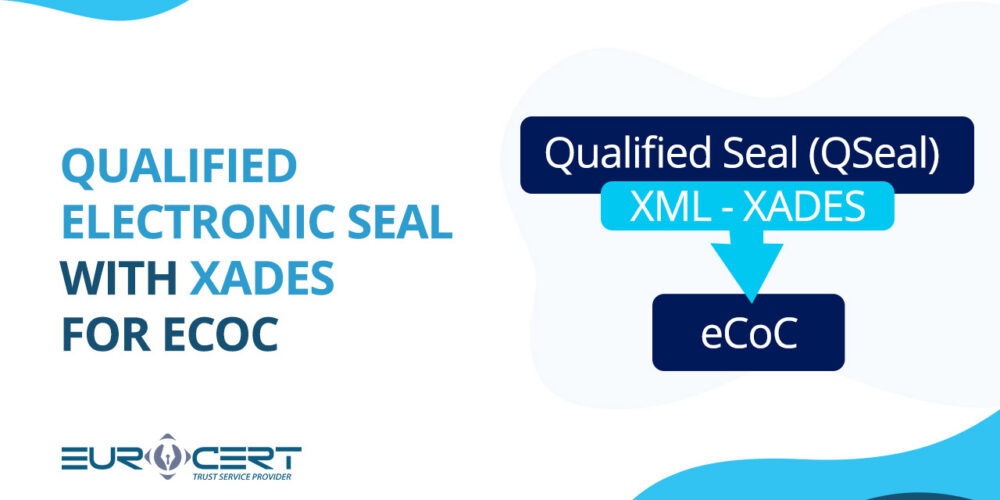
Because the eCoC is stored in XML format, the XAdES (XML Advanced Electronic Signatures) standard is used. This European standard provides data integrity, automated validation, eIDAS compliance, long-term signature validation (LTV) and recognition throughout the EU.
Qualified electronic seals based on an organisation’s data are used to authenticate eCoC Certificates of Conformity. Users may also sign declarations using a qualified electronic signature of a person representing the organisation.
You may also be interested in this article:
Would you like to implement eCoC file signing or obtain more information about it?
Leave your contact details and talk to us about our solutions.
Qualified electronic seal and eCoC
A qualified electronic seal is a digital tool issued by qualified trust service providers, such as Eurocert. It enables the unambiguous identification of the entity authenticating documents and is one of the methods available to vehicle manufacturers for signing eCoCs. When sealing electronic documents, identification data such as the company name, registered office address and information on the tax identification number and type are used. In practice, this makes it possible to confirm that a document was generated by a specific vehicle manufacturer or its authorised entity.
Under European Union regulations, a document bearing a qualified electronic seal is equivalent to its original paper version. At the same time, the seal provides reliable authentication and ensures document integrity. It is particularly well suited to the automated sealing of large volumes of digital files, for example when issuing eCoC Certificates of Conformity.
The second option is a qualified electronic signature, which is assigned to a specific individual and has the legal effect of a handwritten signature under the eIDAS Regulation. In the context of eCoC, however, it requires managing authorisations and certificates for multiple individuals and may create operational risks when staff changes occur. When a qualified electronic signature is used, a specific individual, such as a type-approval engineer, signs the document and assumes responsibility for it.
Due to the specific nature of eCoC, a qualified electronic seal, which identifies the company as a legal entity, is the preferred option when generating Certificates of Conformity. The main advantages of a qualified electronic seal in this application include:
- no dependency on or connection to a specific employee,
- the possibility of automating eCoC generation,
- simple process management for the manufacturer,
- ensuring business continuity regardless of personnel changes.
You may also be interested in this article:
Electronic Certificate of Conformity (eCoC) – what is it? – summary
The Electronic Certificate of Conformity (eCoC) is a digital version of the CoC intended to streamline and automate the exchange of vehicle data in the European Union and the United Kingdom. A digital tool compliant with the eIDAS Regulation is required to authenticate the certificate. A qualified electronic seal should be the preferred solution for manufacturers, although a qualified electronic signature is also acceptable. The mandatory eCoC will enter into force on 29 November 2026, so it is worth preparing for the change in advance.